How Top RV Dealers Approach Insurance
What 67 RV dealerships over four years taught us about insurance, benefits and better deal-making.
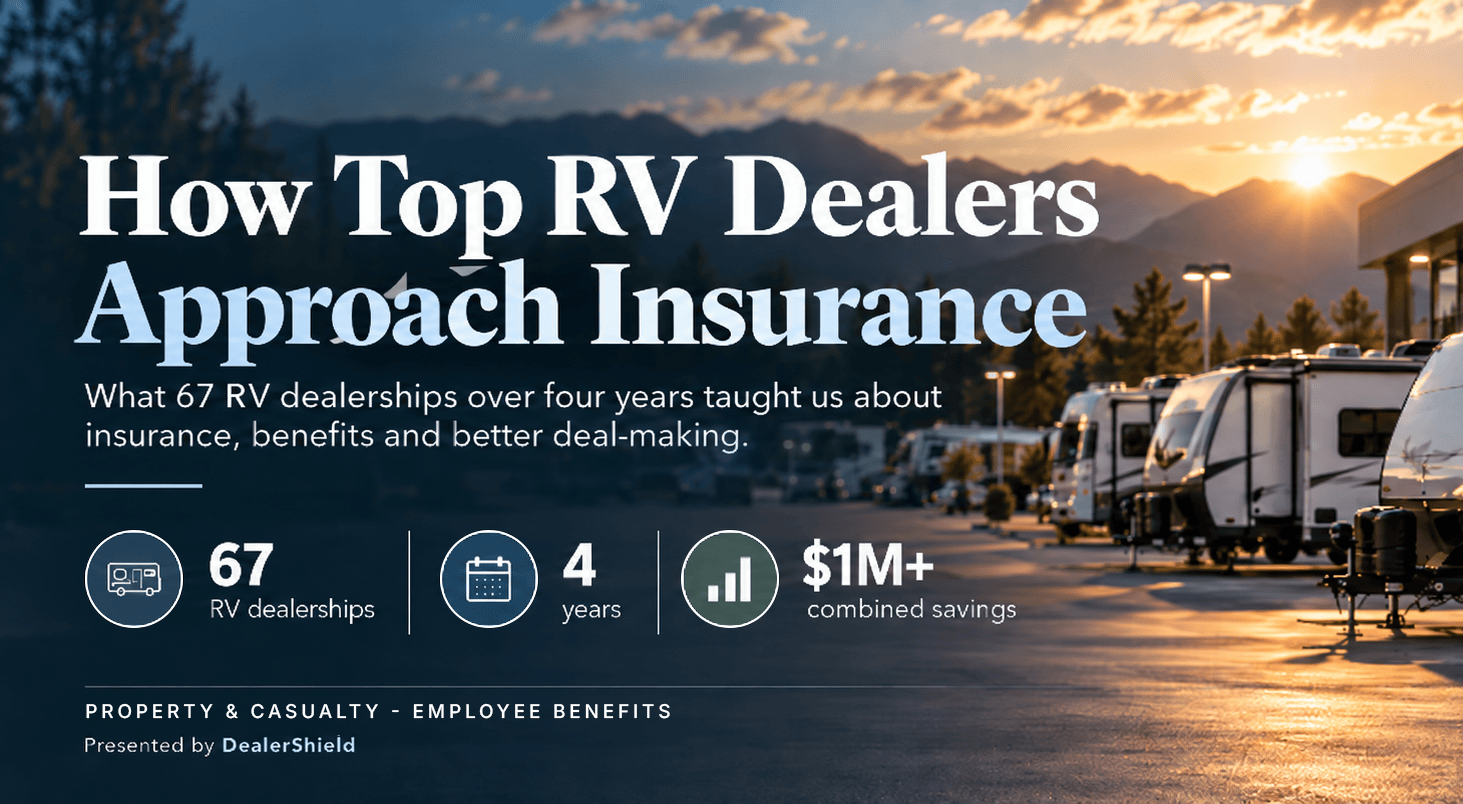
After four years of working with 67 RV dealerships, Dealer Shield has identified more than $1 million in combined property and casualty and employee benefits savings. The biggest lesson is that better outcomes rarely come from RV dealers simply collecting more quotes. The RV dealers that are winning have a straightforward process: Get underwriters’ attention, define the ideal outcome, create competition and leverage, and negotiate the entire deal. This article shares the common-sense framework Dealer Shield has documented across RV dealerships and how you can apply it to their own insurance and benefits strategy.
It is difficult to find an expense line in an RV dealership that isn’t getting scrutiny right now. Front-end margins are tighter. Floorplan and borrowing costs remain significant. Labor, property, healthcare and other operating expenses continue to put pressure on dealership expense ratios. When fewer gross-profit dollars are available to absorb those costs, expenses that may have once received an annual glance suddenly matter a lot more.
Dealership insurance and employee health benefits are two of them.
Over the last four years, we’ve had a front-row seat to how 67 RV dealerships have approached those expenses. Across those dealerships, we’ve seen $871,666 in property and casualty savings and $170,053 in employee benefits savings. More than $1 million combined. The savings certainly caught our attention.
But after watching hundreds of renewals, carrier negotiations and benefits decisions play out, the more interesting finding has been the pattern behind the results. The dealerships that consistently put themselves in the strongest long-term position aren’t necessarily shopping more aggressively or asking more brokers for quotes. They tend to follow a relatively simple process before the first quote ever arrives.
- They get the right people interested in the business.
- They decide what an ideal outcome looks like before going to market.
- They create legitimate competition and negotiating leverage.
- They negotiate the entire deal with resolve.
None of that is revolutionary, especially for RV dealers that know the art of negotiation. In fact, that may be the point.
1. The best outcomes start with getting attention
Insurance is ultimately a market. A dealer may want five insurance companies competing for the account, but that doesn’t mean five good underwriters are interested in writing it. We’ve watched this distinction become increasingly important.
The strongest dealership opportunities tend to get attention because the business is presented in a way that makes an underwriter want to spend time on it. The information is complete. The story makes sense. Loss history has context. Improvements have been documented. The dealership appears organized and serious about managing risk.
The same principle applies to employee benefits. A group that is understood and positioned properly gives carriers and other potential partners something they can actually evaluate and compete for.
This is a subtle but important difference. Getting a quote is not the same thing as creating demand for your business. And when the right people genuinely want the account, everything that follows gets easier.
2. Know what a win looks like before shopping
One of the clearest patterns we’ve seen is that the best deal includes more than the low price. That sounds obvious, but renewal season has a way of reducing a complicated decision to one number. Sometimes the objective really is purely premium reduction, but that doesn’t mean you can’t get inexpensive and good.
Know what you want to push on achieving before you invite carriers to the party.
So before sending information to carriers, the dealerships that navigate the process well usually have some definition of success that they are signaling clearly. For example:
- “I need a 12.5% reduction this year or I’m marketing.”
- “I want to discuss a 3-year rate lock.”
- “I need an aggregate deductible with a reporting provision.”
Maybe the existing program is already strong, and the desired outcome is confidence that the dealership tested the market and truly has the best deal available. That last outcome is easy to undervalue. If communicated clearly, the RV dealers get answers to them all.
There is real value in going through a disciplined process and being able to say: “We tested it. We understand the alternatives. The program we have is the right one.” Saving money is a good result. Confirming you are already receiving a very good deal can be a good result too.
3. Competition creates leverage
Once all the right markets are interested and the dealer knows what it is trying to accomplish, competition becomes much more productive. This is another area where we’ve seen a meaningful difference between having multiple quotes and having real competition. Five proposals sitting on a desk do not automatically create leverage.
Competition becomes useful when credible alternatives are pursuing the same desirable piece of business and there is enough time to work between those options. That changes the conversation, and we’ve found that RV dealers are usually able to go two rounds with carriers that are motivated to win.
The art of the deal is tied to when and how you apply leverage. Then, reward the carrier with the best deal.
4. Your next negotiation begins how this one ends
A good renewal strategy should leave the dealership with more than a policy and a premium. It should close the door on all the markets that competed for the business and leave the door open for their next opportunity. The strongest dealerships carry that information forward into the next year if they are marketing again.
Instead of starting from zero every year, they build on the prior process. The market knows the account better, the dealer understands where leverage exists and weaknesses can be addressed earlier.
Over time, that creates something more valuable than a one-time savings number. It creates price stability, confidence that the market was thoroughly tested and a repeatable process for the following year.
The real benefit may be predictability
The eye-catching result from the past four years is more than $1 million in savings. But in the current dealership environment, we’re increasingly convinced that savings alone are too narrow a way to measure success. Dealers using this approach are also gaining something harder to put on a spreadsheet:
- Price stability
- Confidence
- Assurance in the structure
- And, perhaps most importantly, a repeatable process
You won’t know where you will be next year, but you’ll know what to do and how to do it without burning bridges.
A strategy you can use with or without us
After four years of watching this process work across RV dealerships, our conclusion is pretty simple: a better deal usually begins long before the quotes arrive.
DealerShield is offering RV dealers a customized negotiation strategy built around these same four stages. We’ll look at your current insurance and employee benefits position and approach, identify the outcomes you want, and outline how we believe you should approach the market and negotiation. Then you can decide what to do with it.
You can ask DealerShield to execute the strategy, or you can take it and use it on your own with your current broker.
Either way, the objective is the same: go into your next renewal with a plan, create the right competition and come out knowing you got the best deal available.