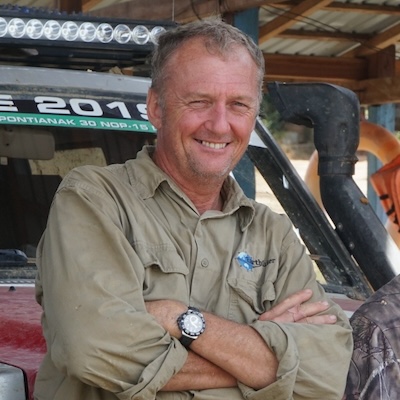
 Lance Gillies of EarthCruiser
This opinion piece as submitted by Lance Gillies, CIO and founder of EarthCruiser Overland Vehicles of Bend, Oregon.
The critics’ list is long and distinguished for the RV industry, particularly the publicly traded big three. Warranty issues, oversupply, consolidation and, of course, lukewarm sales get the headlines. The industry is quick to be judged as a whole when it falls short, it is a complex machine with many moving parts.
Whether those criticisms are fair I am going to leave for others.
It is worth a moment to consider and think a bit differently about the industry and the ecosystem that supports it. What it really does and what it really hides in plain sight.
We are well into the reindustrialization for the United States, to add to that challenge there is the new weird world of AI and questions of what that means for young people entering the workforce.
The United States needs to and is investing in machine learning and automated factories. More importantly is the investment in women and men to develop and hone trade skills, equally important is the development of the managers and leaders.
I reckon the RV industry, their manufacturing in particular, has more than a thing or two to teach us. Maybe they have been ahead of the game the whole time. The RV industry may be one of the largest practical schools of organizational adaptability in American manufacturing.
Having spent the best part of 20 years designing and building expedition and overland vehicles at EarthCruiser on two continents, we never operated at the scale of the major RV manufacturers. Even so, many of the challenges were familiar. The products and production volumes are vastly different, but the experience gives one a certain perspective.
That experience has led me to wonder whether the large-scale RV industry is recognized for the capability it has quietly developed over decades.
From the outside, an RV factory looks like just another manufacturing operation. I think it is something much more interesting, something it does not get nearly enough credit for. Building on something that is going to become increasingly valuable in the coming decade, and it has nothing to do with RVs.
Stay with me.
Unlike automotive manufacturing, where enormous production volumes justify extensive automation and processes built around forecastable repeatability, RV manufacturing operates under entirely different conditions. They have become masters at structuring organized chaos across dozens of competing disciplines with comparatively little automation.
Seemingly their customers constantly want the latest and greatest. New floorplans, appliances, electronics, energy systems and materials all the time. Introducing changes to the manufacturing process is constant, sophisticated battery systems, solar charging, multiplex electrical controls and lightweight composites, just to name a few. This is routine large-scale change to process, not an occasional engineering project on a small volume.
At the same time, outside of the manufacturing, the support systems, the sales teams and customers all need educating on what’s new. On top of that the number of “standard” model variations and options is, well, staggering — an understatement.
Meanwhile, chassis suppliers require high-value commercial forecasts while introducing new platforms, discontinue old ones and make changes outside the manufacturer’s control, with little or no notice. The shrinking pool of component suppliers add or discontinue products, also require forecasts across a huge range. Even a modest RV BOM (bill of materials) becomes thousands of items long, it must have 100% accuracy to build, ship, document and then support into the future.
However, products must remain affordable in the context of discretionary spending, comply with changing regulations, satisfy evolving customer expectations and improve every year without sacrificing quality.
Their customers are both the harshest critics and biggest fans. Nobody has to own an RV. It is a reward for hard work, and it had better deliver. More often than not, it does.
Market demand rises and falls without mercy. Publicly traded manufacturers are answerable to their shareholders, demonstrating they are trustworthy with shareholders’ capital.
Relentless change under pressure is simply the operating environment.
Perhaps that is the capability the RV industry has developed better than most appreciate. Successful companies haven’t simply learned how to build recreational vehicles. They have learned how to build organizations that continually absorb, decode and manage change.
A revised floorplan changes the wiring. A different appliance changes installation procedures. New cabinetry alters assembly order of operations. Updated electrical architecture affects multiple unrelated departments simultaneously.
Every month design develops new concepts driven by the market direction. Engineering adapts systems, purchasing works their magic. Manufacturing adopts the existing production processes into making something new, again. Sales and marketing educate dealers and customers. Quality and after-sales support learn new technologies that barely existed a short time ago. Rinse and repeat.
Yet that same pressure forces successful organizations to develop a unique operating system, it is not just resilience in the face of change, it is change systemized.
Everything around the workshop floor changes and they keep production humming just the same. The real skill is not performing a discipline well. It is performing it consistently well while everything you manufacture, sell and support keeps changing all the time.
This flexibility comes at a cost. It might be one reason the industry wrestles with quality issues and warranty backlogs that get those headlines. When configurations change constantly, quality guardrails and guidelines inevitably come under pressure.
Let’s also keep in mind the cyclic nature of the RV industry without the craziness of COVID. Keeping the entire organization aligned while all of that is happening is herding cats on steroids.
Building the vehicle may actually be the easier part.
The point is, they don’t “just” build RVs.
I would argue they are building something far more valuable: organizational adaptability at scale. The ability to repeatedly design, engineer, source, manufacture, sell and support products while markets, technology and customer expectations refuse to stand still. Without nearly the automation other organizations of similar size can deploy.
Disciplined organizational adaptability is difficult to measure on a balance sheet, yet it may be one of the industry’s greatest assets. Not everything can, or should, be automated. We still need people on the shop floor and people to lead them.
I would argue that tens of thousands of people across the RV industry have spent decades in an environment of managed, disciplined adaptability, change is the expected normal. In that sense, the industry may have quietly been preparing for a future of change at scale that other manufacturing sectors are only now beginning to contemplate.
With young people wondering what an AI-driven workplace means for their future, there is an industry that still appears to thrive because of people.
I think that is pretty special despite whatever happens to be making headlines on YouTube.
Recreational vehicle manufacturers and the industry as a whole do a lot more than just get people outside.