Michael J. Coren of the Washington Post highlighted EV RVs in a recent article. The following is an excerpt:
Last year, manufacturers shipped roughly 342,000 recreational vehicles to American dealers, according to RV Industry Association. Everything from a $10,000 pop-up trailer to a million-dollar land yacht cruising America’s highways. Some are built for weekend getaways; others, for a never-ending road trip.
For decades, the industry barely changed. Three companies — THOR Industries, Forest River and Winnebago — manufacture most of the nation’s rigs in factories around Elkhart, Indiana, mostly using technology that debuted in the 1950s.
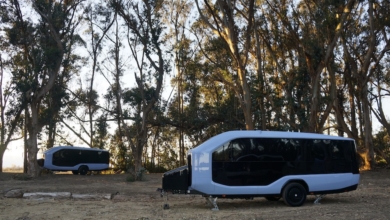
But starting about three years ago, the electric revolution arrived. Incumbents began seriously field testing EV technology, and startups like Lightship and Pebble announced battery-powered, self-propelled trailers.
The result is a new generation of mobile palaces that look nothing like what my dad towed into state parks when we went camping as a kid. The electrification of American camping — at least the car-camping kind — is cleaner and quieter than the era of vibrating generators and hissing propane tanks.
Here’s how millions of Americans may soon spend their weekends, or their year, camping on the road without fossil fuels.
A battery revolution
Manufacturers make two kinds of RVs: towables and motorized. Towables, roughly 85% of the market, are essentially trailers with homes on top. These can be loaded or hitched onto another vehicle. Motorhomes, outfitted with their own engine, range from two-person vans to behemoths spacious enough for a touring rock band.
Until recently, none were electrified beyond a few appliances and hobbyist vehicles. It wasn’t until about 2017 that major manufacturers, especially in Europe, got in the game, notably Dethleffs’ “e.home” concept. More experiments followed, but none made it to market.
The main problem: cost and range. Hauling an eight-ton vehicle shaped like a brick down America’s highways creates enormous aerodynamic drag: Motorhomes regularly get 10 miles (or less) per gallon, while trailers slash that already-lackluster fuel efficiency by 30% to 50%.
But as batteries have improved and gotten cheaper, the era of electric RV has finally arrived.
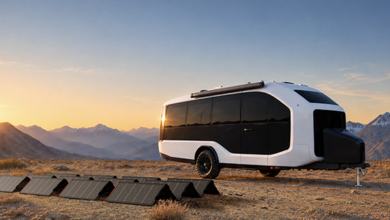
Startups Lightship and Pebble are both manufacturing the first all-electric RVs: battery-powered trailers that propel themselves. The technology consists of a large battery, roughly equivalent to those in an electric SUV, as well as a motor that drives the trailer’s wheels, using sensors that match acceleration and braking, sharply reducing the trailers’ drag on the vehicle towing it. The batteries also power amenities such as all-electric appliances and climate control. Solar panels top off the battery along the way.
This approach, argues Pebble spokesperson Ryan Levenson, replaces a patchwork of legacy systems — propane appliances, lead-acid batteries, portable generators — with a single electric platform. Pebble’s software also automates chores RV owners love to hate, like leveling, hitching and monitoring energy and water levels. “More than the technology,” he wrote, “it’s about making ownership feel less intimidating, more accessible and hassle-free.”
Click here for the full report, including more about models from Lightship, Pebble, Winnebago and Entegra Coach.