Class B’s Maintain Their Cool

While U.S. sales of Class B motor-homes have softened a bit, manufacturers maintain that growth is not far off.
Indeed, demographics favor a growing boom.
Year-to-date through September (the latest data available), some 829 Class B motorhomes were sold in the U.S., according to Grand Rapids, Mich.-based Statistical Surveys. The number is expected to increase by about another 70 units or so for the nine-month period as more updated information flows in, according to Tom Walworth, general manager of Statistical Surveys.
That’s still just about half the number sold through September 2007, when Class B’s racked up 1,817 sales – the highest in the last five years. Sales reached 1,100 for the same time in 2008, then plummeted to 872 in 2009. In 2010, 1,159 Class B’s were sold, according to Statistical Surveys.
Meanwhile, Class B shipments to dealers for 2012 are projected to hit 1,900 for 2012, the same number forecasted for 2011, according to the RV Industry Association.
A couple of key factors have slowed Class B sales, Walworth says.
First, many are manufactured in Canada, which means that with today’s stronger Canadian dollar they are more expensive for American buyers. The higher cost of diesel fuel is another drag on sales. Most Class B’s are built on a diesel Sprinter chassis, which tacks on another 20 to 30 cents per gallon at the pump compared to gas-powered motorhomes.
And while Class B sales in Europe have been boosted by a growing demand for smaller motorhomes, Walworth says he does not expect a similar trend here.
“The B van is a great vehicle, but in the United States you have so many other options for probably a lesser dollar and bigger units that people kind-of look at it and say: ‘Do I really want to do this?’” he says. Often, for the same amount of money, an American RVer can buy a Class C or an entry-level Class A gas motorhome with much more room and storage space, he notes.
The segment’s top manufacturer is Roadtrek Motorhomes Inc., based in Kitchener, Ontario, Canada, with a 48 percent market share, followed by another Canadian-based manufacturer, Pleasure-Way, with 24 percent of the U.S. market. Jackson, Ohio-based Airstream Inc. rolls into third place at 16 percent. Other players with smaller pieces of the market include Great West Vans and Winnebago Industries.
Still, Class B sales will climb, predicts Jeff Hanemaayer, Roadtrek co-chairman, pointing out that part of the slump occurred when Winnebago decided to put its Era model on hold in 2011.
“Class B will continue to be a growing segment,” Hanemaayer says. “Demographics bode well for Class B sales in the long term. Over the long term, the aging population works most favorably to the Class B market because the Class B market has the oldest buyers.”
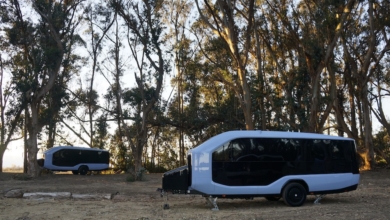
Airstream seems to have found a winner with its Interstate model, despite a price tag that can run $30,000 more than competing models. Airstream says customers appreciate the many amenities included standard in the motorhome. In 2011, Airstream began offering the Interstate in a black exterior, and now 50 percent of Interstate motorhomes are produced in black due to popular demand.
|
Airstream Inc.
Class B sales are soaring for Airstream, which revamped its staff when it decided to branch out from its signature aluminum motorhomes. It was not a commitment made lightly. The company restructured its sales force and hired Tim Garner as its new general manager for touring coaches. So far, those moves seem to have paid off.
Last summer, Airstream introduced a new floorplan for its Avenue model that has been “well-received in the market,” Garner says. So far, sales have done well for the Chevrolet-based platform Class B, in the neighborhood of 50 units.
For 2010, Airstream sold 125 of its other model, the Interstate, and the number keeps rising.
“Our business has doubled in 2011 on the Interstate,” Garner says. “This year (2011), we will hit right at 250 retails.”
In a way, the development of the Interstate tells the story of how Airstream got into the Class B market. The unit was the product of focus groups and questionnaires to owners of Airstream motorhomes in late 2010.
The result was a roadmap that led to the Interstate.
“We wanted to create something different. That’s what people love about our product,” Garner says. “In order for us to be successful early, we have to be different somehow, some way. Our big thing is innovation and differentiation. Customers will pay for that if they realize that we have something unique. We have become the highest-priced B van (in the $130,000s) in the nation and it’s growing. It’s fascinating.”
The research continued this year with surveys of dealers “to try and better understand where our brand could go that others would find harder to follow,” Garner says. “We really have a unique brand.”
For instance, the Interstate exterior, Garner says, “is so unique and different than anything else out there.” It includes a complete full-body kit on the Sprinter chassis, “basically a cargo van that we turned into a premium luxury vehicle,” he says.
“It has a low, aggressive stance, high-end aluminum wheels. … Part of our research pointed to our exterior design. It doesn’t look like a big motorhome going down the road. It looks like a luxury touring coach and there’s not a lot of graphics, either.”
Because it’s such a high-end product, Airstream also paid a lot of attention to luxury features and amenities. Indeed, research showed that the more features Airstream added, the more it supported the company’s premium position.
“It’s attracting luxury buyers in the space,” Garner says. “They love the amenities onboard – the bathroom, the lounge you can sleep in, if you want to. A lot of them never really stay in it overnight.”
It’s also attracting new and younger buyers. Half of the buyers of the Airstream B models have never owned an RV and they use them more like a weekend camper and touring coach, Garner says.
Another characteristic of the Airstream Class B buyer: 80 percent are cash buyers, they do not have credit challenges, and it’s a quick turnaround from shopping to buying.
“It’s people who know what they want,” Garner says. “It’s not six to nine months – it’s six to nine days. It’s a different world, to be honest with you.”
Still, one of Airstream’s biggest challenges has been to persuade buyers to fork over more dollars to buy into the Airstream brand.
“We’re in the $130,000s – in some cases $30,000 more than some competitors,” Garner says. “Most of the time the wives gravitate toward ours and say ‘This is the one we want.’ We have to clearly demonstrate why we are at that position. That’s our biggest challenge, but we are overcoming that, obviously.”
One of Airstream’s biggest surprises was a departure from the traditional – with a black Airstream.
In 2010, the models were offered in white and silver. Silver, Garner says, represented 80 percent of sales at the time.
“We’ve often been had the request: ‘Hey, why don’t you build a black one. We actually had a dealer who painted a silver one black because a customer requested it, so we tested in the summer a handful in black. When rumors got out that we were building a black one, virtually every one of these pre-sold without anyone ever seeing them. It’s a crazy business case story.”
Further testing confirmed it.
“They retailed as fast as we could get them. Last summer to early fall, we decided to offer black; our production is (now) 50 percent black and retails very well. It has subtle chrome trim all around and has a great look and feel to it. What really is new and exciting … is the black one.”
Airstream also added a new in-dash system, teaming up with Kenwood in Europe, for a high-end navigation system and multi-media system standard. It includes iPad integration, Bluetooth technology and a 7-inch touch screen. Navigation includes live traffic data, lane assist, and a function that helps users find the most fuel-efficient route.
“This whole in-dash system really kind-of set us apart as well,” Garner says. “It hit a sweet spot with our customers.”
For the near future, Airstream has just introduced an extended Sprinter platform for the Interstate, which is 16 inches longer than the current Interstate. It’s played well with dealers in Louisville, and was launched publicly at the Tampa SuperShow in January.
Other new features include thorax side airbags, front and rear audio, and visual sensors. The extended version will have price of $135,305.
“If you want to take six or eight people on a road trip, you can do it with this thing,” Garner says. “We’re really excited about the new extended (version).”
“We found a sweet spot,” Garner adds. “We look to grow that into next year. We will continue to push envelope on design, to separate from other companies.”
|
Roadtrek Motorhomes
Although Roadtrek is No. 1 in Class B sales, retail sales are down 7 percent to date, mostly due to economic conditions. On the plus side, the company soared to record levels in market share at 49 percent.
The best is yet to come, Hanemaayer says, thanks to the growing number of baby boomers.
“The average buyer for Roadtrek is 62-63 years old,” he says. “And 30 percent of our buyers are over the age of 70. People don’t typically buy Class B’s for price, they buy them because they are small and they get the features they would normally find in a larger motorhome. They are also easier to drive and park than the larger models.”
Boomers, he adds, are a demographic bulge that likely will provide a bit of a boom for Class B’s over the long haul. Indeed, the segment is just now seeing the “beginning edge” of the boomer population, he says.
“If you think of a bell curve for our baby boomer buyers — the middle being at 63, when you’ve got only the beginning of the baby boom at that same age — it takes about 10 years for the average baby boomer to reach the mid-spot,” Hanemaayer says.
That demographic could result in a 10- to 20-year growth market for Class B’s, Hanemaayer says.
Today’s family structure also bodes well for Class B’s. The average family has two or fewer children, a good fit for the smaller RVs.
“They’re more likely to be satisfied with an RV that sleeps four than an RV that sleeps five or six,” Hanemaayer says. “Families also take shorter vacations more frequently than the once a year … so having a Class B sitting in the driveway ready to go for a short weekend getaway or for a day at the beach makes more sense than a family having a large motorhome sitting in storage.”
What keeps Roadtrek in the top spot?
“There’s not just one or two things,” Hanemaayer says. “It’s a combination of things. In the end, we provide the best combination of price, design quality and service, what I call product value.”
Models range from the 170-Versatile, which seats seven and sleeps two to four on the Chevrolet Express 2500 van, to the SS-Ideal, a sleek model on the 144-inch wheelbase Sprinter 2500 van. Prices range for the mid-$60s to the low $100,000s.
The recently introduced N6-Active, built on the Nissan N 2500 series van, has the usual amenities, can tow up to 9,000 pounds, and gets up to 18 miles per gallon. It has space for seven, and includes a third row big enough for two adults or three children. It retails for $67,470.
Other features that drive buyers to Roadtrek include a four-year, 48,000-mile warranty, the industry’s biggest Class B network of dealers, and a long reputation of top quality.
Its performance seemingly cemented in the U.S., Roadtrek plans to make a foray into the Chinese market, where it is already working with a couple of dealers. Roadtrek hopes to sell about 250 vehicles a year in China.
“We’ve been around since 1974 and have been No. 1 since 1990, which speaks for itself,” Hanemaayer says. “That we’ve been able to dominate a segment like that shows that we know what we are doing and that the customers are speaking with their wallets.”
|
Pleasure-Way
While Pleasure-Way managed to keep its retail numbers for 2011 at the same level as 2010, its wholesale shipments are up 19 percent over 2010 and a whopping 43 percent over 2009.
In February, the Saskatoon, Saskatchewan, Canadian-based Class B maker reported a record sales mark – its’ highest for the month since 2008.
“More consumers, and therefore more RV dealers, are looking for smaller, more fuel-efficient and easy-to-drive motorhomes,” says John Mattern, Pleasure-Way national sales manager. “Pleasure-Way has been known for its quality of fit and finish over the past 25 years. A lot of dealers stock motorhomes, but they have an A and a C and they stop there. That makes the customer leave their lots, so now a lot more dealers have a Class B.”
Key to its success is Pleasure-Way’s manufacturing method. Each unit is made individually.
“We have good quality of fit and finish of the interior,” Mattern says. “They are well-made. When we install and build our cabinets, nothing is prefabbed on a bench and then installed. Everything is custom build on that coach.”
Still, selling Class B’s – or any motorhome these days – is not a task for those who give up easily. Mattern says one of Pleasure-Way’s largest obstacles is educating consumers to the advantage of Class B’s.
“For example, high gas prices are here to stay,” Mattern says. “Pleasure Way motorhomes average 14-22 mpg highway mileage. No other size of motorhome offers this fuel efficiency.”
They are also easy to drive. At 20 to 23 feet long, they are about the size of a regular half-ton truck.
“Many of our owners are first-time RV owners and can be intimidated by the size and amenities of larger Class A and Class C motorhomes,” Mattern says.
To overcome pricing comparisons with Class C’s, Pleasure-Way pegs its Class B’s from the high $60s to more than $100,000.
Pleasure-Way’s best-seller is the Ford Excel, the top-selling Class B single model motorhome in North America. The Excel, a wide body, represents half of Pleasure-Way’s sales. It comes with a full private bathroom, king-sized bed, front and rear dinettes with full kitchen and cooking facilities.
“Not a lot of companies offer wide-body motorhomes,” Mattern says. “It’s us and Roadtrek and our MSRP is $12,000 to $13,000 less than theirs.”
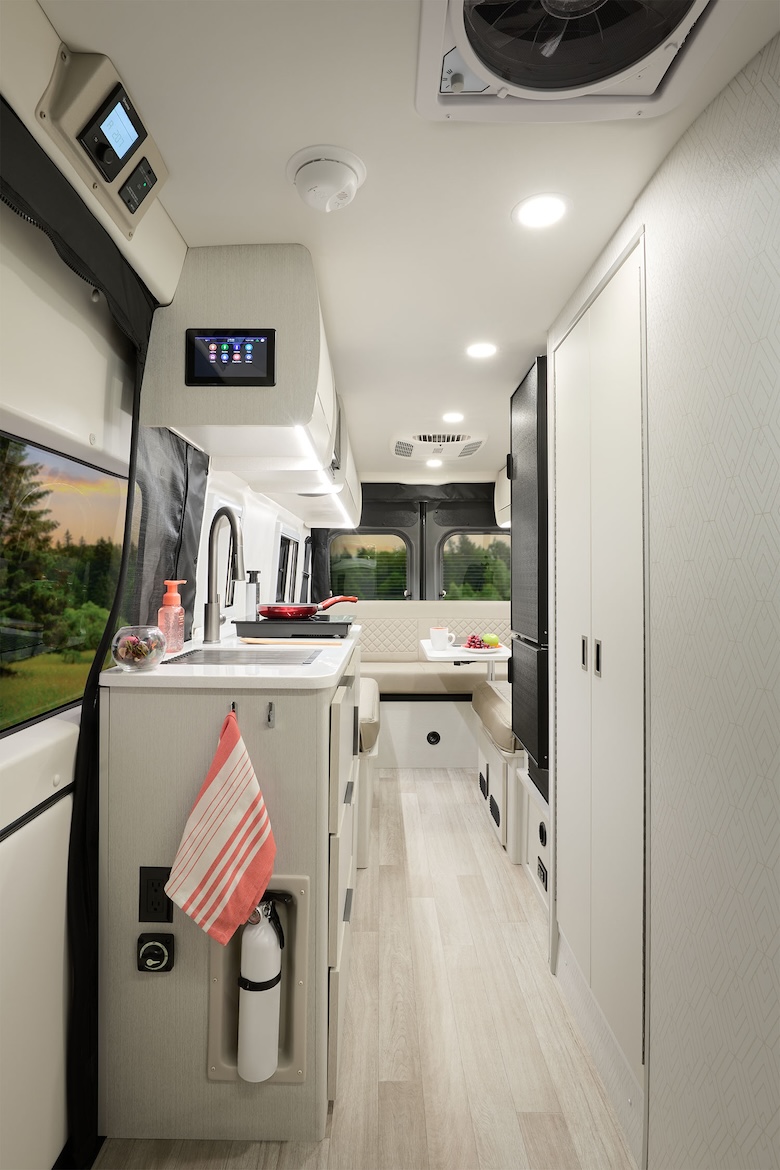
Pleasure-Way also has introduced the Plateau RB floorplan on the Mercedes-Benz Sprinter chassis, which features a 76-inch by 70-inch permanent bed with a dual density memory foam mattress and more than 20 cubic feet of under bed storage. It also includes sliding maple doors with frosted inlay to separate the bedroom from the rest of the coach with a front dining and entertainment area, private bathroom and large kitchen area. The unit retails for $113,670.
The Basis, at a more entry-level price of $69,940, is built on the Chevrolet Express 3500 chassis and includes a V8 engine and six-speed transmission to go with its built-in roof air conditioner, dual coach batteries, awning, maple cabinetry and seating for four and sleep space for two.
In the high-tech arena, Pleasure-way has introduced LED lights, a back-up camera with Bluetooth capability and 22-inch LCD HD televisions. A raft of new products is coming in 2013, Mattern says.
“This is what we’ve been doing for 25 years,” Mattern says. “We build Class B motorhomes. It’s what we specialize in.”
Pleasure-Way has introduced the Plateau RB floorplan on the Mercedes-Benz Sprinter chassis, which features a 76-inch by 70-inch permanent bed with a dual density memory foam mattress. It also includes sliding maple doors with frosted inlay to separate the bedroom from the rest of the coach with a front dining and entertainment area, private bathroom and large kitchen area.
|
Winnebago Industries
After a brief hiatus, it’s a new Era for Winnebago.
Winnebago is back in 2012 with its popular Class B Era model. (The Forest City, Iowa, manufacturer didn’t produce the model in 2011.) In 2010, when it was introduced, it had a 15.9 percent market share. Through October, it has a market share of 6.2 percent.
Now it’s back, with increased fuel efficiency and a base price of $95,397. The most popular options are the 2,500-watt Onan MicroQuiet LP generator, awning, Sirius satellite radio and water purification system. With those options, the price jumps to $101,113. Other options include aluminum wheels and an infotainment center with GPS on a 7-inch monitor and removable wardrobe.
“In the B van section, we’re really not a van manufacturer,” says Russ Garfin, director of product planning. “Maybe it sounds like semantics, but we didn’t build these vans until we started building motorhomes on the Sprinter chassis. … It’s a bit different than taking a small van and trying to make something people can camp in. Our approach is different. It’s really a motorhome. We’re building a compact and efficient motorhome and fitting that into the B van category.”
For instance, the seats in the Era are the same chairs in larger Winnebago motorhomes.
Responding to customer demand for increased storage space and increased seating, Winnebago went from single rear tires to dual.
“We took the time and decided to build on the dual-tire version of the Sprinter chassis,” Garfin says.
That move allowed Winnebago to offer the optional wardrobe that allows travelers to have more storage. More storage also was added in the overheads and the back. LED lighting and LED television, which require less energy, also were added.
“I think the people who buy that vehicle are pretty tech-oriented,” Garfin says. “I know the LED lighting on the inside and LED television are things customers told us they really wanted and that they really appreciate.”
The refrigerator also has been upgraded to operate in a warmer environment with additional fans.
While Winnebago’s primary market remains the retiree, the Era opens the door to soccer moms who have children who play in tournaments over the weekends. It has seven belted positions, which makes it a good vehicle to transport those young soccer players. Moms also can bring their own food to daylong tournaments, Garfin says.
“There’s a lot of benefit to having a base camp,” he says. It’s a segment, says Garfin, which Winnebago wants to grow.
“We have some aspirations with the Sprinter product. We expect to be the No. 1 Sprinter B van,” he says.
“The idea is that this is a small motorhome, that’s our direction. To make functionality, the most flexible and most efficient motorhome out there. We are looking to do that.”
Leave a Comment
Please sign in to leave a comment
Click here to Sign in. Don't have an account? Join Today (It's Free!)


.jpg)