Giving Your Storage Space Breathing Room
By applying these techniques to organize your goods, you can increase efficiency and gain space for in-demand products.

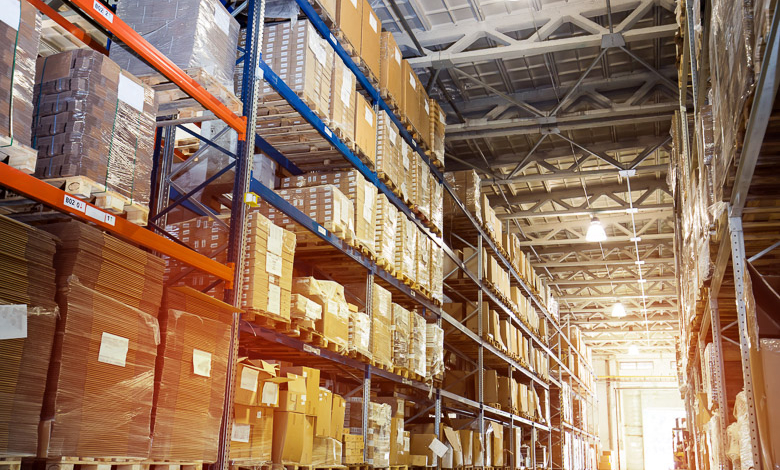
In more than 50 years of working with inventories of goods, I have discovered that one item has almost always been in excess in most of those inventory storage areas: AIR!
And by air, I refer to unused storage space.
Too often, inventory managers think in two dimensions when placing goods in the storage areas of their inventory department. Yet in a storage unit/area, space/volume has three dimensions: width, height and depth. Optimally, using all three of these dimensions when storing goods can enable more efficient placement of goods and could increase the efficiency of workers within that inventory environment.
A Space Challenge
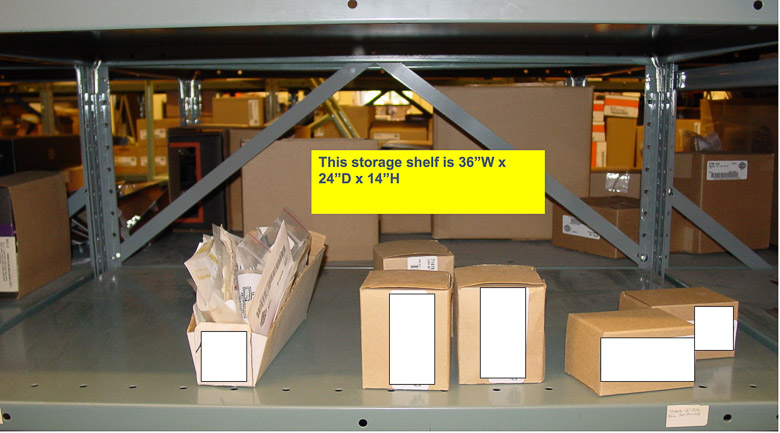
A client contacted me with a problem regarding the storage areas of his business. His parts and accessories inventories were contained in three areas, and he was concerned that some of these areas could be accessed by unauthorized personnel. He wanted to combine all the stored goods in one primary storage area. This primary storage area had five rows of storage racks that consisted of 10 units each measuring 36 inches wide by 24 inches deep by 120 inches in height (50 units total). In addition to these, there were some other storage units for special storage. As shown in the image below, there was a large volume of AIR stored in many of these units.
Over a 10-day period working after hours, an associate and I:
- Removed one unit from four of the rows so the personnel didn’t have to walk more than 15 feet to get an item in an adjacent row. This reduced the total number of these storage units to 46!
- Established the spacing between shelves within these units where goods having a height relatively equal to the shelving spacing could be placed.
- Used compartmentalized storage containers where appropriate to use the entire 24 inches of depth of each shelf.
- Assigned bin locations to each item and entered these bin locations in the dealership management system (DMS) so that personnel could efficiently stock and retrieve goods.
- Erected additional storage units along a wall where goods had previously been stacked on top of each other.
- Transferred small items from the large storage racks to modular drawer units.
- Located frequently requested items proximate to the workstations to further reduce travel time for the associates.
Upon completion of this project, my client was certain that we had tossed goods into the trash container because he was amazed that we were able to condense the storage so effectively.
Space Utilization Tips
 My associate and I applied some inventory storage concepts that I had developed in my 50-plus-year career of managing and consulting in the inventory industry. Those of you who have been reading my columns know that I believe in the concept of bin locations. If an effective bin location system is in place within an inventory storage area, then personnel can efficiently stock goods and retrieve goods because each item has been assigned a home (bin location or locations if necessary) that is listed in the DMS database. If you have not developed and maintained a bin location system, then these other concepts might be of only limited use in your inventory storage area(s).
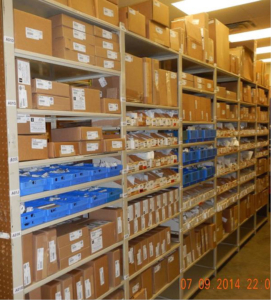
Another of these inventory management tools I have developed is termed the size/quantity concept. To apply this concept, it is necessary to group goods by size and/or quantity so that items having similar heights can be assigned to the same shelf (or shelves), which minimizes the wasted space. This can be accomplished for goods that have a similar height or by placing multiple pieces of small goods in containers of similar height. This image (above right) illustrates this size/quantity concept.
My skipped letter/number concept is another tool that I have developed that coordinates with the concepts of bin location and size/quantity. Since an inventory of goods is in a state of flux with items entering and exiting depending on the volume of demand, it is necessary to allow for modification of the storage equipment and areas in which these items are housed. To easily accommodate these modifications, I suggest assigning bin locations using a series of skipped letters or numbers. The image below illustrates this.
Notice the labels (A03M, etc.) on the upright in the left of the image below show the shelf bin locations and that the uppermost shelf in the image is A03M, while the next lower shelf is A03P. These inform us that these items are in Aisle A, Rack 03, and on Shelves M and P. And, as shown in the blue bin box that is open, the first item has a bin location of A03M3A, while the second item has a bin location of A03M3C because that item requires two spaces in the bin box.
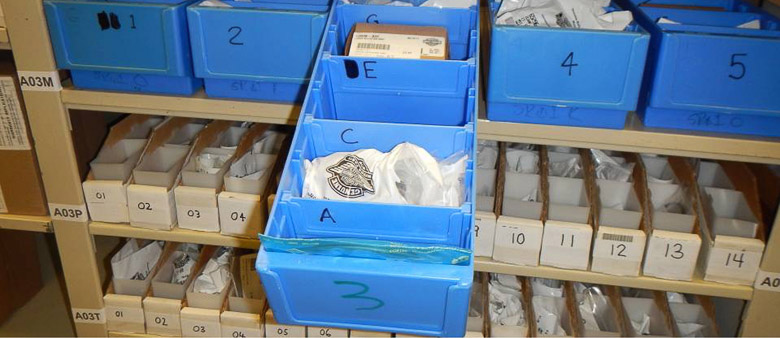
If demand for the item in A03M3C decreases, the space is available for other items. Perhaps these happen to be two different items that are small enough to fit in one division each. These items would be assigned bin locations of A03M3B and A03M3C respectively and the items occupying the divisions behind A03M3C would not have to be assigned new bin locations.
Benefits of Exploring Your Space
If you are interested in maintaining your inventory accuracy, which we discussed in my March and April columns in RV PRO, then you have learned that it is important to have accurate bin locations. This requires that bin locations be assigned to new items you have added to your inventory and to delete bin locations for items that are no longer in your inventory.
By applying the concepts explained in this month’s column, you can easily assign bin locations to the new items by locating a space that can accommodate the size/quantity of these new items. Whereas if you place items in part number sequence, usually a lot of effort is required to place any new items into the part number sequence.
By finding more space, perhaps you could stock a larger mix of goods that your customers are requesting. And perhaps you could place frequently required goods more proximate to the workstations, thereby minimizing the time and footsteps required to issue those goods.
Is It Worth the Effort?
By optimizing your storage volume, you could enhance the opportunity of increasing your sales volume. You decide if that result is worth the effort to explore your storage space.