Jayco Charges Ahead With New Class A Strategy
Jayco tackles Class A headwinds with sharper price points and an innovative, extended-range Embark electric motorhome.
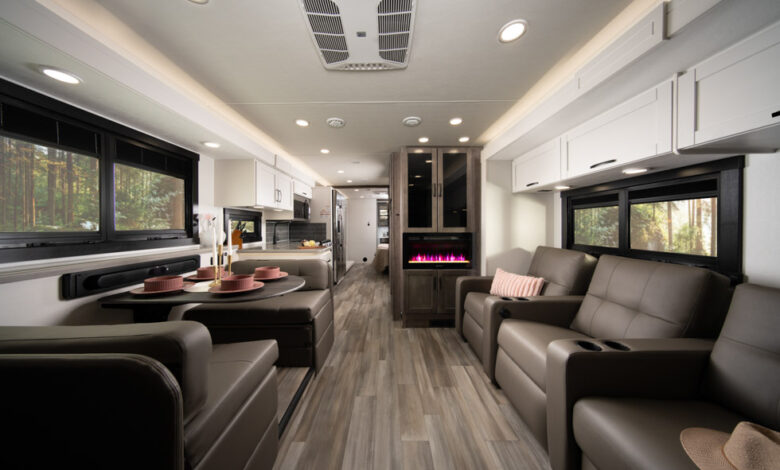
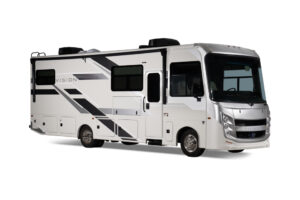
Amid a difficult market for Class A models, Jayco is pushing innovation in its effort to navigate economic obstacles. Overall, the Class A market continues to be challenging, and Jayco has adjusted with new models. It has been seeing success with low-end Class A and low-end Class C. On the Entegra Coach side, the company developed the entry-level Vision SE — then it moved up to a Vision, then a Vision XL and then the Emblem.
Jayco developed the Vision SE to try to get to a price point that is nonexistent, post-COVID-19, simply because chassis prices keep increasing, according to Cory Weatherton, Jayco director of product development.
Tariffs became a factor in early fall 2025. The Vision SE has sold well, when chassis can be found. The Ford F-53 plant has cut back production significantly. Last fall, every manufacturer was struggling to get F-53 chassis. Many suppliers of other parts anticipated the effects of tariffs, so they ordered more products in advance.
“[For] the bulk of our builds, our better margins are in the higher end versus the lower end, so we were building a lot of painted Visions, painted Vision XL — those are options,” Weatherton says. “Why would we do that? Because the lowest price point is doing well, but at the same time, as a manufacturer, we have seen a lot of success with painted units. It gives the appearance of a higher-end unit. The Class A market is a tough market right now.”
Weatherton also notes that aluminum and steel prices are high. Jayco tries to mitigate price increases by either switching to U.S. manufacturers when possible or sourcing from a country of origin with lower tariffs.
“Our purchasing team is doing a good job in identifying the country of origin so that we can try to address that. Obviously, China has some of the highest tariffs. We have some manufacturers of components that were building in China but have moved to Indonesia or Malaysia, or other Asian countries, in order to sidestep those tariffs.”
Embarking With Extended Range
Jayco made headlines earlier this year when it gave a peek at its innovative Embark EV. While it remains to be seen if the new model will usher in an era of electric RVs, it offers potential for market expansion.
Jayco brought the electric Embark to its homecoming event in Texas in August, as an unbranded unit, but with the knowledge it would be released as an Entegra. The unit subsequently generated considerable buzz at the Elkhart Open House. Jayco is now making revisions to the EV.
Jayco will launch production during the first quarter of 2026, exclusively for Tourism Holdings Limited (THL), a New Zealand-headquartered tourism and RV rental company with U.S. operations based in California. THL has ordered an undisclosed number of the model. The plan is for THL to use the units — in essence giving them a test run for a year — and then provide feedback from their customers. Weatherton anticipates releasing the model to the retail market in the third quarter of 2027.
Weatherton is quick to clarify that the Embark EV is an electric motorhome with range-extended power. It is not technically a hybrid, but rather an electric lithium chassis with a range extender, one of the first electric models in the RV industry with such an extender.
“The way it functions is the range extender is a gas-powered generator. The first choice of the motorhome, it can run off of the lithium power. You are going to get about a 105-mile range when you put it in what most folks would understand as a hybrid mode, where it is running off both gas and electricity. But it is different, because it is technically not running on gas; the generator is constantly, slowly charging the lithium battery, so it is always running off of lithium. If I use the generator, I go from a 105-mile range to a 450-mile range, depending on the terrain.”
Jayco’s parent company, THOR Industries, has a U.S. innovation lab that gives Jayco an advantage in product development. There was a sorting out of chassis under consideration before Harbinger was selected. THOR brought a couple of different chassis to the Jayco campus to try. Jayco tested them and found the range was lacking.
“There was one company that would not allow us to tap into the battery system, to use it for the house portion of the electricity,” Weatherton recalls. “We knew right away that with limited range, and not being able to fully utilize the battery packs, those were not good options.”
At the 2024 Elkhart Open House, THOR brought a concept vehicle it had built, and at that point, it was just on lithium power. It did not yet have the range extender.
“From THOR interacting with Harbinger, they agreed one of the biggest issues is range. The average RV customer is going to want to drive more than 105 miles in a day. Harbinger then developed the range extender, and THOR presented us with the opportunity to build on that chassis in October 2024.”
Development took about 10 months. As Jayco was creating the house part, Harbinger was developing the range extender.
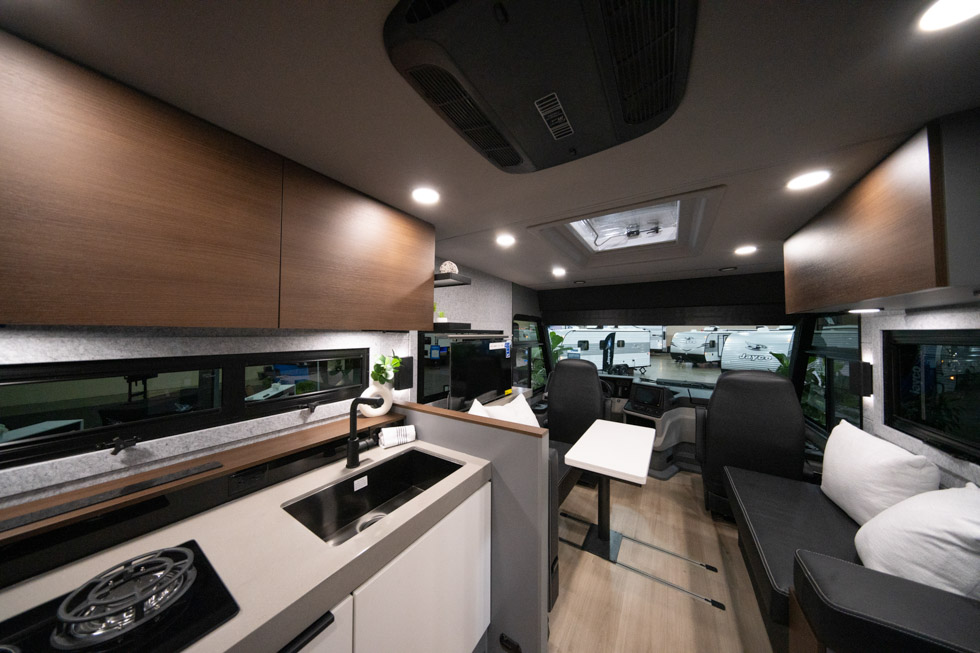
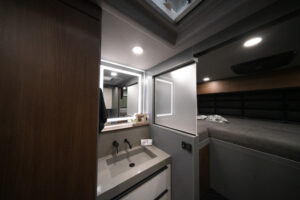
“We knew we were going to build this motorhome; we just did not know on what chassis. As a team, we had started to meet in July of 2024, identifying components, sourcing those components, developing the layout and dealing with possible obstacles. We knew we wanted a flush floor and a walk-in shower, which we don’t do on our gas series.”
With redesigns in progress and furniture changes being made, Jayco doesn’t have a final cost of the new units yet, but Weatherton estimates it will be in the $400,000 range.
“With that, customers need to understand that compared to the F-53 chassis, this chassis is significantly more expensive,” he explains. “Here at Entegra, we build vans and Class Cs that have just standard lead acid batteries in them. As soon as you place a 9-kilowatt-hour battery in it, the price goes up $20,000. This lithium battery is significantly even larger than that, 100 kilowatt hours, so that is going to take the price up a lot more. We designed the unit a lot cleaner and sleeker, something a former pusher customer or a first-time customer would recognize as a higher-end unit.”
The Future of EVs
Weatherton says whether Jayco and THOR continue building other electric vehicles depends on the chassis manufacturers. It helps that Harbinger is a relatively new startup company that has already worked with the major names in the automotive industries. He notes that the current cost of electric RVs is prohibitive for many RVers.
“I believe the typical combustion engine is going to be around for as long as the government allows it,” he says. “However, as regulations gradually change, we will see more of these chassis come into the market. It will be up to the chassis manufacturer, and also the RV manufacturer, to figure out how to make it affordable to RVers. The price is likely to come down as the technology evolves.”
Jayco has had many online inquiries asking how individuals can rent the new Embark. Jayco directs them to THL, which is placing names on a waiting list to be contacted as soon as units are available to rent. THL tends to keep its rental units for about 12 months, so he anticipates used units will be available by the spring of 2027.
“There may be dealers who scratch their heads over the EV motorhome and wonder how it makes sense, but many will be excited about what the future holds for the RV industry and will understand how the chassis and the lithium batteries affect the cost,” Weatherton says. “The dealers who have seen it absolutely love the housing portion of the unit.”
A More Modern Feel Inside
Weatherton observes that some diesel pusher customers are moving to gas vehicles, which are at a lower price point, but still seeking the amenities of a pusher.
“The hard thing about that is, a lot of pushers have the diesel Aqua-Hot system in them, in-floor heat, etc.,” he says. “A gas chassis obviously is not a diesel chassis, so some of the components are limited. The size of the chassis was maxing out at a 20,000 pounds, which limits the amount of weight it can carry, so some of the things we have in our pushers, such as a porcelain tile floor, we just can’t do.”
Jayco is opting for residential vinyl plank flooring for a sleeker, integrated look. Valences were removed, and windows with integrated blinds were installed in some models.
Jayco is also making the move to tankless water heaters across all of its models. New interiors are featured.
“We have tweaked some this year for the next model year. We will be releasing new interiors as far as cabinet styles, and new colors to give the units a more modern feel. Trends we are seeing in the RV industry are generally years behind the residential housing industry, but we are moving to more painted cabinetry, as wood tones are starting to disappear. We have oversized all our cabinet door and drawer fronts, in order to give it a cleaner look, such as in a real home,” Weatherton says.
“[In] the Embark, if you look at the pictures, you will see no Shaker-style doors or Colonial-style doors. These are all flat panel doors with no hinges or handles visible. You will start to see more of this in the coming years. The product has been pretty dialed in, so we are only doing small tweaks. We have been doing well as a manufacturer in gaining market share, but we are not resting on our laurels by any means.”