On Friday, Feb. 20, in a 6 to 3 decision, the Supreme Court held in the case of “Learning Resources/V.O.S. Selections” that President Trump DOES NOT have the authority to impose tariffs under the International Emergency Economic Powers Act (IEEPA), the RV Industry Association (RVIA) reported.
At a press conference following the Court’s decision, President Trump announced that “effective immediately,” he will impose 10% global tariff under Section 122, and the Administration will initiate several 301 investigations. The RV Industry Association will provide updates on these actions as they become available.
Of note, the Court did not weigh in on whether or how the federal government should provide refunds to importers who have paid the tariffs, instead leaving it to the US Court of International Trade.
The Majority Opinion
IEEPA is a United States federal law authorizing the president to regulate international commerce after declaring a national emergency in response to any “unusual and extraordinary threat” to the United States. A separate provision of the law states that when there is a national emergency, the president may “regulate…importation or exportation” of “property in which any foreign country or a national thereof has any interest.”
The majority opinion, written by Chief Justice Roberts, focused on that second provision, determining that “regulate” and “importation” do not grant the President “independent power to impose tariffs on imports from any country, of any product, at any rate, for any amount of time.” The opinion also noted that IEEPA contains no references to tariffs or duties, and no President has ever read it to grant such power. The decision reshapes the balance of power between the president and Congress over trade and emergency powers, clarifying that a president may not unilaterally determine tariff policy to this extent under this law.
President Trump’s Options Moving Forward
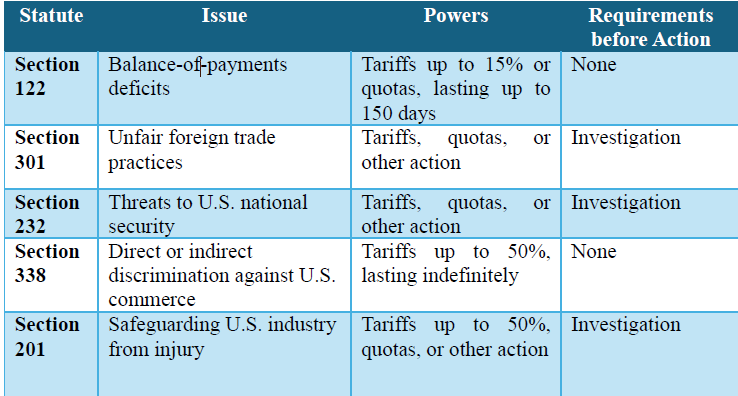
The President has been adamant that tariffs will remain a central part of his economic policy and the administration has said they have plans to impose tariffs utilizing other authorities. Justice Kavanaugh’s dissent, likewise, states that “numerous other federal statutes authorize the President to impose tariffs and might justify most (if not all) of the tariffs at issue in this case—albeit perhaps with a few additional procedural steps[.] Those statutes include, for example, the Trade Expansion Act of 1962 (Section 232); the Trade Act of 1974 (Sections 122, 201, and 301); and the Tariff Act of 1930 (Section 338).”
However, those statutes are more limited in their authority. For example, Section 122 allows the president to impose tariffs but limited to 15% and only up to 150 days. Section 301 requires an investigation by the Commerce Department and US Trade Representative.
The RV Industry Association team is working with our trade partners to review the decision and will update members with additional information as we receive it.
To read the Supreme Court Opinion, click here.
For a detailed breakdown of the decision, click here.
Please contact RV Industry Association Director of Federal Affairs Samantha Rocci at srocci@rvia.org with any questions, and keep up with the latest tariff updates here.
The following was reported by NBC News.
The Supreme Court delivered a major blow to President Donald Trump, ruling Friday that he exceeded his authority when imposing sweeping tariffs using a law reserved for a national emergency.
The justices, divided 6-3, held that Trump’s aggressive approach to tariffs on products entering the United States from across the world was not permitted under a 1977 law called the International Emergency Economic Powers Act (IEEPA).
The ruling invalidates many, but not all, of Trump’s tariffs.
Speaking at the White House, Trump harshly criticized the Supreme Court majority, describing the decision as a “disgrace to our” nation and the justices in the majority as “very unpatriotic and disloyal to the Constitution,” while suggesting they were “swayed by foreign interests.”
Trump’s ability to impose tariffs using other laws is not affected by the ruling, and Trump said he plans to use those authorities to impose new duties on a global basis. He said he will soon implement a 10% global tariff, which would be a reduction for nearly all foreign nations.
Despite Trump’s rhetoric about the tariffs benefiting the economy, stocks rallied on news of the ruling.
The ruling was authored by Chief Justice John Roberts, who was joined by three liberal justices and two fellow conservatives, Justices Neil Gorsuch and Amy Coney Barrett, in the majority.
“The president asserts the extraordinary power to unilaterally impose tariffs of unlimited amount, duration and scope,” Roberts wrote. But the Trump administration “points to no statute” in which Congress has previously said that the language in IEEPA could apply to tariffs, he added.
As such, “we hold that IEEPA does not authorize the president to impose tariffs,” Roberts wrote.
Justices Clarence Thomas, Brett Kavanaugh and Samuel Alito dissented.
It is a rare setback for the administration at the Supreme Court, which has a 6-3 conservative majority, since Trump began his second term in January.
Business owners who had to pay the tariffs and challenged them in court expressed relief at the ruling.
“These new tariffs were arbitrary, unpredictable, and bad business,” Victor Schwartz, who runs New York-based wine and spirits importer VOS Selections, said in a statement.
“Thankfully, courts at every level recognized these duties for what they were: unconstitutional government overreach,” he added.
The decision does not affect all of Trump’s tariffs, leaving in place ones he imposed on steel and aluminum using different laws, for example. But it upends his tariffs in two categories. One is country-by-country or “reciprocal” tariffs, which range from 34% for China to a 10% baseline for the rest of the world. The other is a 25% tariff Trump imposed on some goods from Canada, China and Mexico for what the administration said was their failure to curb the flow of fentanyl.