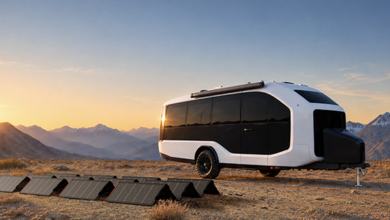
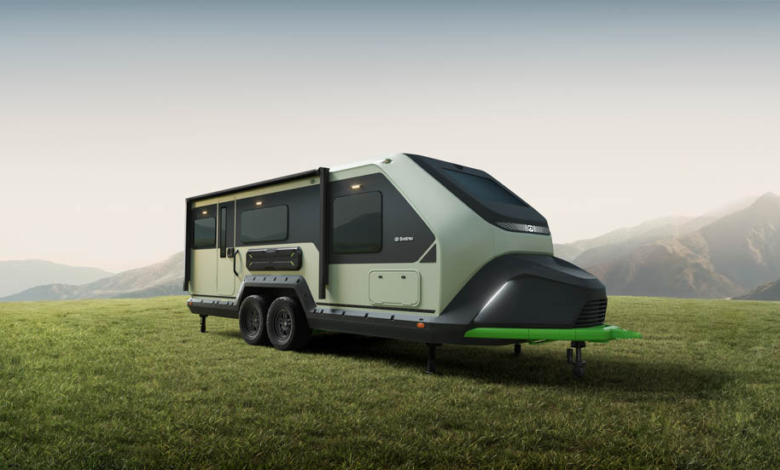
The following is an excerpt from The Future of EV RVs from the April 2026 issue of RV PRO magazine. For the full Q&A printed in that issue, click here.
What segment is your company electrifying first? Why is that the segment your company is going with?
Cory Weatherton, senior director of product development, Jayco Family of Companies:
Class A. In order to get the driving range that the average RVer expects to travel at one time we had to find a chassis manufacturer that would work with us in developing a range extender for the electric chassis. A rail chassis made the most sense for us to start building on, simply due to the GVW needed in order to carry the weight of the batteries as well as the range extender.
Royer Allman, vice president – chassis administration, Forest River Inc.:
Other/none of the above. At this time, we are keeping all segments open for consideration. The RVEX concept was positioned between a Class A and Class B motorhome, but moving forward, we are not limiting our exploration to a single segment. Electrification potential exists across multiple motorized classes, and final direction will depend on chassis viability and market readiness. Rather than committing to a specific segment today, Forest River is maintaining flexibility. As technology evolves, the segment that offers the best balance of range, weight capacity and consumer demand will guide our decision.
Ivan Wang, chief marketing officer, Evotrex:
Towable/travel trailer. Evotrex’s mission is to transform outdoor experiences for the adventurous through pioneering technology and insight-driven innovation, reimagining a lifestyle that goes beyond electric — one that’s intelligent, enjoyable and without compromise. We are starting with the RV trailer to immediately tap into a massive community of outdoor enthusiasts. It is the perfect platform to showcase how innovative technology can fundamentally elevate the outdoor experience.
Sam Shapiro, founder and CEO, Grounded:
Class B/ camper van. We think this is the most comfortable, easily maneuverable RV segment, and most practical for an EV, given that larger units would require larger batteries and have less range.
Toby Kraus, co-founder and CEO, Lightship:
Towable/travel trailer. Towing is where electrification can have the greatest impact. Conventional trailers can reduce EV range by 50% or more due to aerodynamic drag and weight. By integrating self-propulsion and aerodynamic optimization, we meaningfully mitigate that range penalty. This approach solves a core industry pain point while preserving flexibility; customers can detach the trailer and use their tow vehicle independently.
What are the benefits of an EV RV for the end user & what are the challenges?
Weatherton:
There are a few benefits of an EV RV for the end user. The two most notable are the ride and handling of the coach as well as, obviously, fuel efficiency. With the Entegra Coach Embark, the unit is incredibly quiet while driving down the road. Compared to an E450 or F 53 chassis, it is a night and day difference in the drive experience. Currently, there is not a Class A or Class C chassis on the market that could have the desired range for an RVer running solely with a lithium battery bank. It was critical that we worked with a manufacturer that would be able to incorporate a range extender onto the chassis. The chassis range extender runs off of gasoline and recharges the battery bank while driving down the road. So, while fossil fuel is still used in order to get the desired range for the end user, the fuel economy is considerably better than what your traditionally powered fossil fuel RV would be.
Allman:
The benefits of an EV RV for the end user include:
- Increased ability to operate off-grid
- Greater self-sufficiency and energy independence
- Reduced carbon footprint
- Quieter operation
- Integration of advanced electrical systems and smart technology
Challenges include:
- Range limitations under load
- Vehicle weight constraints
- Charging infrastructure that is still developing
- Longer charging times compared to refueling
Wang:
A traditional travel trailer is a heavy, un-aerodynamic brick. It lowers gas mileage and absolutely destroys EV range. All-electric trailers try to fix this by using their battery to assist with towing, but that drains the power you need for actual boondocking, forcing you right back to crowded campsite hookups. We built Evotrex to eliminate that compromise. By integrating an ultra-efficient power generator, our trailer automatically recharges its own battery. You get seamless tow assist on the highway and limitless power for off-grid camping when you arrive.
Shapiro:
The immediate [benefit] is the driving experience. Electric drivetrains are smoother, quieter and more responsive than diesel or gas and have no engine vibration at camp, no exhaust fumes, no gas station stops. You wake up, unplug and go. Then there’s the energy system. Our G3 carries up to 20kWh of house batteries that recharge from solar, shore power or the vehicle’s own drivetrain via our 1,400W vehicle-to-house system. That means genuine off-grid capability without a generator. Owners can monitor and control everything: power usage, tank levels, appliances, etc., remotely through our Grounded+ app. Charging infrastructure is the biggest [challenge]. It’s improving fast (our G3 works with both CCS and Tesla Superchargers) but route planning still requires more thought than pulling into any gas station. Range is sufficient for most travel days at 286 miles, but topping off at camp versus on the road is a mindset shift. Weight is another factor. Batteries are heavy, and that limits how much payload you can carry compared to a gas van with the same GVWR. We’ve addressed this by using aluminum framing and lightweight recycled materials throughout the interior, but it’s a real engineering constraint.
Kraus:
An electric RV fundamentally improves the camping experience. Owners benefit from quiet operation with no generator noise, the elimination of propane systems, and lower operating and energy costs over time. Integrated rooftop solar enables extended off-grid capability, while regenerative braking and propulsion assist improve towing efficiency and reduce strain on the tow vehicle. The AE.1’s 77 kWh battery is comparable to roughly five to six residential battery systems, effectively turning the trailer into a mobile microgrid. In addition to powering life off grid for days at a time, it can also serve as backup power for a home when needed. Challenges: The primary challenge today is charging familiarity and infrastructure awareness. While charging networks are expanding rapidly, rural travel corridors can require more planning and education. We addressed this by designing multiple redundant charging pathways, DC fast charging, Level 2, campground shore power and solar, giving owners flexibility and confidence wherever they travel.