The following is an excerpt from The Future of EV RVs from the April 2026 issue of RV PRO magazine. For the full Q&A printed in that issue, click here.
How will consumers charge their EV RV? Can the infrastructure match the demand?
Cory Weatherton, senior director of product development, Jayco Family of Companies:
The end user will be able to charge the RV chassis while at home, at campgrounds or any EV charging station. Because of the flexibility of the charging options, weather through the gasoline range extender, or one of the previously mentioned electric options, we believe it will not be difficult for the end user to be able to power the electric chassis.
Royer Allman, vice president – chassis administration, Forest River Inc.:
Consumers would charge via public charging networks along highways and, ideally in the future, upgraded campground charging stations. However, charging infrastructure is still maturing and is not yet fully aligned with the unique demands of larger EV motorhomes. We anticipate infrastructure development will continue over the next several years, and widespread EV RV adoption will likely follow that growth.
Ivan Wang, chief marketing officer, Evotrex:
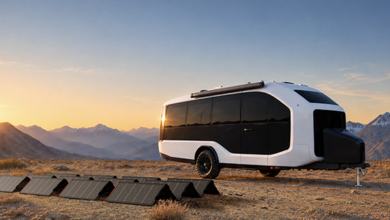
Solar power, regenerative charging while towing, AC charging via the NACS charge port. Horizon’s optimized, fuel-efficient operation at up to 75 kW when towing, and 20 kW when parked with regular gasoline.
Sam Shapiro, founder and CEO, Grounded:
The G3 charges natively on CCS fast chargers and comes with a CCS-to-NACS adapter for access to the Tesla Supercharger network, which is the largest fast-charging network in North America. Between the two, our owners have access to tens of thousands of charging stations nationwide. A typical fast charge session gets you back on the road in under an hour, and most owners also plug in at campgrounds or at home on Level 2 overnight, to wake up with a fully charged battery. No charging stop needed. The infrastructure isn’t perfect yet, but it’s improving faster than most people realize. Tesla opening its Supercharger network to non-Tesla vehicles was a massive inflection point, quickly expanding the fast-charging options available to our customers. And federal NEVI funding is adding thousands of new stations along highway corridors over the next few years. For RV travelers specifically, more campgrounds are adding EV-capable hookups, and we’re seeing the industry start to treat electrification as inevitable rather than experimental.
Toby Kraus, co-founder and CEO, Lightship:
The AE.1 offers multiple charging pathways to give owners flexibility on the road and at camp. It supports DC fast charging up to 155 kW, Level 2 charging and standard 30A/50A campground shore power. In addition, its integrated rooftop solar system helps offset daily living loads, particularly during extended off-grid stays. On travel days, DC fast charging enables rapid energy replenishment, while the large onboard battery allows owners to arrive at camp with substantial stored energy, reducing reliance on immediate plug-in access. As electric truck adoption grows, corridor fast-charging infrastructure continues to expand, and we expect that trend to accelerate. Campgrounds are already equipped with high-amperage hookups, but many operators have an opportunity to further enhance the guest experience by adding EV-specific charging stations and implementing energy management systems to support the growing number of electric RVs.
Is there anything else we should know about your company’s current EV RVs?
Allman:
While full EV production is still maturing, Forest River continues to actively explore electrification. A hybrid approach, combining electric propulsion with a small internal combustion engine to achieve 400-500 miles of range, may serve as a transitional solution before fully electric platforms become viable at scale. Importantly, our EV development work has already yielded meaningful innovation. Lightweight construction techniques and advanced electrical components initially developed for electric concepts are now influencing and improving our broader product lineup. Forest River remains committed to innovation and thoughtful exploration across our product offerings. As the industry evolves, we are actively preparing for what the future holds for RV enthusiasts.
Wang:
Evotrex launched a digital tool that helps RV campers plan extended off-grid trips with a realistic view of energy and water autonomy. The Off-Grid Calculator was developed alongside the Evotrex-PG5, a power-generating RV trailer, to model real-world travel conditions based on customized needs. Campers can adjust variables like climate, daily appliance usage, water consumption habits, and travel patterns to transparently understand how their setup will perform during off-grid stays. One of the biggest challenges in the RV market today is the confusion surrounding off-grid capability claims, as consumers are often presented with impressive performance figures without any clear explanation of the assumptions, variables or calculations behind them. Evotrex is addressing this gap with a transparent, data-driven calculator designed to simplify these claims and give travelers a clear, realistic understanding of what their off-grid experience will actually look like.
Shapiro:
The G3 now seats up to five passengers. We recently launched rear seating for up to three in the living space, in addition to the two in the cab. That was one of the most requested features from our early customers and a major step toward making the G3 a true family-capable vehicle. Every G3 is built to order through our online 3D configurator at configurator.groundedrvs.com. Customers choose their chassis, floorplan tier, cabinetry colors, countertop textures, bed configuration and equipment packages, then watch the build come to life in real time from any angle. Our modular platform is being used across commercial verticals including mobile health, food and beverage, trades and municipal services. That dual consumer-commercial model means we’re building volume and learning across a much wider range of configurations than a pure-play RV manufacturer would. Every commercial build makes our consumer product better, and vice versa. We think that flywheel is what sets Grounded apart in this space.