The following is an excerpt from The Future of EV RVs from the April 2026 issue of RV PRO magazine. For the full Q&A printed in that issue, click here.
What is your company working on in the EV RV arena?
Cory Weatherton, senior director of product development, Jayco Family of Companies:
For the past two years, we’ve been in development on a Class A that sits on an electric chassis with a gasoline range extender.
Royer Allman, vice president – chassis administration, Forest River Inc.:
Forest River is currently in a prototyping and exploration phase, evaluating multiple EV chassis platforms. While we previously introduced the all-electric concept RV, the RVEX, we are not yet in full production on an EV platform. Our focus today is exploring viable chassis partnerships and continuing internal development work to prepare for the future of EV RVs.
Ivan Wang, chief marketing officer, Evotrex:
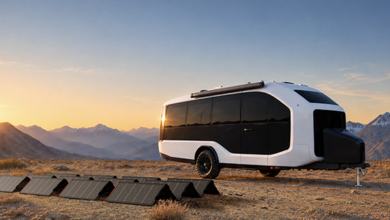
We’re building the Evotrex-PG5, the world’s first power-generating RV trailer. Rather than simply putting a large battery into an RV trailer, we’ve designed a unified and intelligent electric ecosystem that works seamlessly to deliver real off-grid power. The PG5 is engineered to make off-grid living sustainable. By providing its own motive force and capturing energy via regenerative braking, the trailer significantly reduces the overall energy consumption and carbon footprint of the tow vehicle. The 1.5 kW rooftop solar array continuously replenishes the battery with clean energy. Instead of a traditional, noisy RV generator that runs constantly, the Horizon generator only kicks on when the battery reaches a low threshold or whenever needed. It runs at peak efficiency to quickly recharge the battery (up to 75 kW when towing, and up to 20 kW when parked), drastically cutting down on fuel use and local emissions. When not out on the road, the PG5 can be used as a clean, efficient backup energy source for a house during grid outages, exporting up to 12 kW of clean and quiet power.
Sam Shapiro, founder and CEO, Grounded:
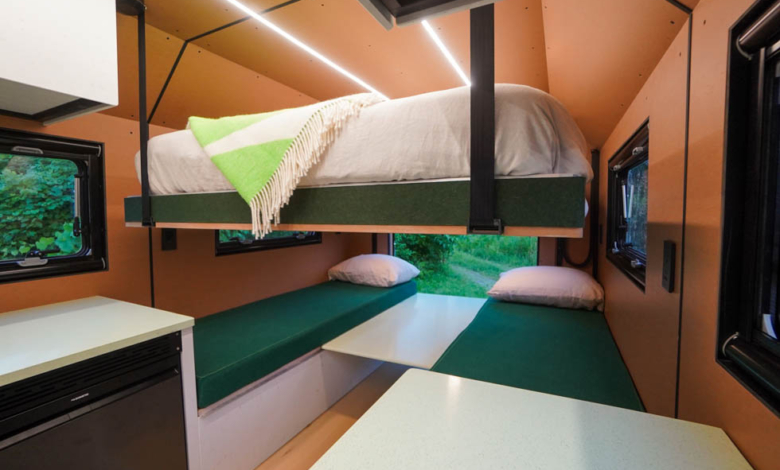
Last summer, Grounded launched the G3, our third-generation, all-electric camper van built on the Chevrolet BrightDrop Zevo platform. It delivers 286 miles of combined range with all-wheel drive and is engineered for true four-season use, down to 0°F. The G3 is available across three configuration tiers starting at $211K, and customers can design their build through our online 3D configurator tool at configurator.groundedrvs.com. Every G3 comes with Grounded+, our integrated smart RV app that gives owners full remote access to their vehicle’s living systems via LTE or Bluetooth. Through Grounded+, users can monitor real-time power usage, check tank levels, control appliances and run system diagnostics from their phone, whether they’re inside the van, sitting at camp or miles away. It dynamically adapts its interface to match the exact configuration of each customer’s build, so no two dashboards look the same. The G3 is a ground-up reimagining based on real-world feedback from our G2 owners. We replaced wood cabinetry with durable aluminum frames and 100% recycled tree-free materials; added a motorized lift bed that converts to a California King; reengineered our electrical system for 1,400W vehicle-to-house charging; and designed a new insulated rear swing-out door that improves thermal efficiency without sacrificing the view. We also added self-heating LiFePO batteries to enable reliable four-season travel. Beyond the RV consumer, we’ve expanded into commercial applications: mobile health, food and beverage, municipal, and trades verticals, using the same modular platform. Our system works like configurable building blocks, so we can rapidly customize a build for drastically different use cases on the same electric chassis. We have also launched rear seating in the G3 for family trips.
Sustainability is built into the G3 at every level, not just the drivetrain. The vehicle itself is fully electric and zero-emission, with access to CCS fast chargers and Tesla Superchargers via an included NACS adapter. But we’ve pushed well beyond that into how the living space is built and powered. All cabinetry is constructed without wood. Our panels are made from 100% recycled materials, including reclaimed household appliances and single-use plastic utensils. The material is homogenous, meaning it’s more durable than veneered surfaces, never requires edge banding, and resists warping and wear over time. The structural framing underneath is industrial-grade aluminum.
For off-grid power, we offer up to 1,000W of rooftop solar and up to 20kWh of modular LiFePO house batteries that can recharge via solar, shore power or our 1,400W vehicle-to-house system. The self-heating batteries maintain performance in extreme cold without external energy input. Combined with improved 2-inch EPS foam insulation and our redesigned rear door, the G3 maintains comfort and power availability in harsh conditions while minimizing energy waste. The goal is full off-grid capability so our customers can spend extended time in nature without leaving a footprint.
Toby Kraus, co-founder and CEO, Lightship:
Lightship is building the AE.1, a fully electric travel trailer designed specifically for the EV era. Instead of retrofitting a traditional RV platform, we engineered from scratch to rethink what a trailer could be, making it dramatically more efficient, higher performing and far more sustainably engineered . At the core of the AE.1 is a 77 kWh battery, the largest in its category, paired with 1.8 kW of integrated rooftop solar. The trailer is fully electric, with no propane system and no gas generator, which means quiet camping and zero on-site emissions. Under typical use, a family of four can expect approximately one week of off-grid capability supported by onboard storage and daily solar production. One of the biggest breakthroughs is TrekDrive, our proprietary self-propulsion system. The trailer actively assists the tow vehicle using onboard motors, reducing drag and energy loss. This can deliver up to three times the efficiency of towing a conventional trailer, extending range for electric tow vehicles and improving fuel economy for gas trucks. The AE.1 also supports bi-directional charging, which opens up some powerful use cases. It can charge an EV at a campsite or serve as home backup energy during an outage, with storage capacity comparable to multiple residential battery systems. In other words, it’s not just a trailer, it’s a mobile energy asset. Taken together, these features make the AE.1 a premium, road trip–ready electric trailer that rethinks how RVs interact with energy. By combining thoughtful aerodynamics, solar power generation, large-scale battery storage, and intelligent propulsion, we’re able to significantly reduce the environmental impact of RV travel, without compromising comfort or performance.