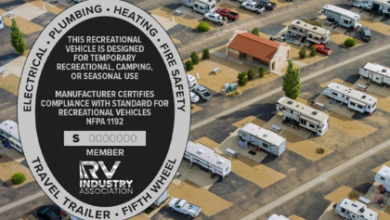
The RV Industry Association (RVIA) said it is proud of its standards inspection program and everything the RV Industry Association seal represents. Not only does this program verify association members’ self-certification of compliance with the adopted standards and participation in several unannounced audits each year, but it also supports RVIA members’ commitment to maintaining self-regulation by providing education and guidance on adhering to the association’s adopted standards.
Federal Vehicle Regulations Covering RVs
The RV Industry Association seal only signifies the members’ self-certification to adopted standards related to the portion of the RV containing temporary living quarters. The vehicle portion of the recreational vehicle — both towable and motorized — is regulated by the National Highway Traffic Safety Administration (NHTSA) under its promulgated regulations for motor vehicles. NHTSA has a separate label requirement that signifies the self-certification of compliance with federal regulations.
NHTSA is a U.S. federal agency under the U.S. Department of Transportation, and its mission is to save lives, prevent injuries and reduce economic costs due to road traffic crashes through education, research, safety standards and enforcement. NHTSA is primarily responsible for investigating potential safety defects, managing and enforcing recalls, and promulgating Federal Motor Vehicle Safety Standards (FMVSS). FMVSS are federally mandated standards that apply to motor vehicles, including RVs.
RVs must meet certain FMVSS depending on whether it’s a motorized or towable RV. All RVs must comply with several FMVSS, including but not limited to requirements for lamps and reflective devices, tires, brake fluids, VINs, labeling, record retention and recalls. Motorized RVs must also comply with seat belt requirements and testing along with other safety-related standards, some of which are met and certified by the chassis manufacturer and passed through to the RV manufacturer.
Differentiating Federal Standards & Enforcement
Each RV manufacturer that applies for RV Industry Association membership must submit specific NHTSA documentation as evidence that they have registered as a motor vehicle manufacturer with NHTSA. The Association requires this documentation to ensure that each member has notified NHTSA of its intent to build an RV, a motor vehicle.
Since FMVSS are federally mandated and NHTSA has its own investigations and enforcement divisions, the Association does not and cannot inspect or enforce FMVSS when auditing the RV manufacturers for compliance with the Association’s adopted standards. The Association does educate its members on their NHTSA obligations. For example, the Association has a Regulatory & Safety Compliance Subcommittee that meets to discuss NHTSA and FMVSS-related developments and best practices for recall management. The Association also holds an annual Regulatory & Safety Compliance Seminar to discuss additional NHTSA and FMVSS topics.
Canada also has its own regulations through its NHTSA counterpart called Transport Canada. Transport Canada has promulgated the Canadian Motor Vehicle Safety Standards (CMVSS), its counterpart to NHTSA’s FMVSS, as well as certain recall obligations.
The Federal Self-Certification
RV manufacturers, just like all other vehicle manufacturers, must affix a federal certification label on their units self-certifying that their RVs conform to all applicable FMVSS in accordance with NHTSA regulations. Similarly, if a vehicle is sold in Canada, a certification label must be affixed to such unit self-certifying its compliance to all applicable CMVSS in accordance with Transport Canada regulations.
NHTSA Recall Authority
Although there is a clear delineation between the vehicle portion of the RV, which must meet NHTSA’s FMVSS, and the portion containing the temporary living quarters, which must meet the Association’s adopted standards (if an RV manufacturer member), NHTSA does regulate the entire RV when it comes to recalls. A vehicle that contains a defect that results in an unreasonable risk to motor vehicle safety is subject to a recall, regardless of the relevant standard.
Recalls do not just apply to RV manufacturers. The component part suppliers who supply parts to RV manufacturers are considered motor vehicle equipment manufacturers by NHTSA. For example, whether it is a microwave, AC unit, seat belt, or battery in an RV, NHTSA requires all the equipment manufacturers of such products that go into an RV to be recalled in accordance with NHTSA regulations when there is a defect that impacts motor vehicle safety.
A Step Above
When RV manufacturers affix an RV Industry Association seal on their units in addition to their federally required FMVSS certification label, they are going above and beyond the federal regulations. By doing so, they are also certifying that they are adhering to safety standards relating to electrical, plumbing, heating, fire and life safety, and other component subsystems, as adopted by the RV Industry Association’s Board of Directors. RV manufacturer members submit themselves to unannounced audits from RV Industry Association inspectors who verify compliance with these adopted standards, and the Association only provides seals to manufacturers that continue to adhere to those standards. This framework advances the industry’s and the government’s shared commitment to safety.