Achieving Inventory Accuracy, Part 2
The service department and parts/accessories department can work together to reduce RECT.

This column is the second of a two-part series (click here for Part 1, which originally appeared in the March 2026 issue of RV PRO) that offers some methods to maintain the accuracy of and the equivalency of your parts and accessories inventories values, and to offer methods of decreasing your RECT (repair event cycle time).
WHAT Is To Be Identified as Inventory?
I introduced this aspect of inventory management in Part 1. Defining what is inventory is important because your RV business purchases many types of goods. It is important that at least the accounting manager and the parts/accessories manager agree as to which of these goods qualifies as inventory and which qualifies as direct expense.
This is important because if the parts/accessories manager receives an item to an inventory category in the dealership management system (DMS), yet the accounting manager posts that item to an expense account, then the B and C values are not equivalent.
NOTE: B value is “book” (accounting) value; C value is “computer” database value.
Related to this situation is the review of and approval of the invoices for all goods. It is imperative that the parts/accessories manager review and approve all invoices for goods because she is the purchasing agent and should be familiar with the reason for each of those purchases.
I suggest that any invoices for goods be provided to the parts/accessories manager for approval and coding of the amounts to the appropriate general ledger account on each invoice. If the parts/accessories manager assigns the appropriate general ledger accounts to each invoice in compliance with the policy of what is inventory and what is expense, then this could enhance the accuracy and equivalency of the B and C inventory values.
Perhaps an example will assist you in understanding why I am suggesting that the parts/accessories manager review and code all invoices for goods. A client of mine provided me with this example. A supplier invoice contained two pages with the first page showing that tires were shipped with an extended cost of $200 and a freight charge of $3.60. The second page of the invoice showed that four training tapes were actually shipped at $50 each with a state tax of $2.50 for each tape. Several errors impacting the values of the parts and accessories inventory, as well as the freight and state tax general ledger accounts, existed because the accounts payable clerk posted from page one of the invoice.
If the parts/accessories manager had received and reviewed this invoice prior to it being sent to the accounts payable associate, then the errors could have been noticed. The primary flag to the parts/accessories manager would have been the $3.60 freight charge, which would not normally cover the freight of shipping four tires.
The appropriate general ledger accounts could have been assigned to each of the values shown on the two pages of the invoice and the invoice could have been coded as:
-
- $200 to the Parts-Training expense G/L account
- $10 to the State Retail Tax G/L account
- $3.60 to the Parts-Freight G/L account
If you decide to implement this suggestion, then you might have to train your parts/accessories manager to use the General Ledger Chart of Accounts so that she could know to which account each invoice line should accrue.
What Is the Unit of Measure for RECT?
Your service department inventory relates to RECT, and the unit of measure is a factor of time. By reducing the time required to process the tasks involved in a maintenance or repair service, you gain more time to sell, without having to add technicians. You could also increase the possibility that you can provide a customer requested service when it is convenient for the customer — possibly enhancing your customer service rating.
Inventory Accuracy Drives RECT Efficiency
Depending on your billable hourly rate for service, your RECT could increase the income for your service department. Therefore, if your parts associates can more efficiently support your service technicians, the RECT could decrease. If your parts and accessories inventory is more accurate, this enables your parts associates to quickly fill the parts requests of the service technicians.
Interdepartmental Communications Drives RECT Efficiency
What if the parts associate could pull in advance some, or possibly all, of the parts, accessories and materials that a technician might require for a specific maintenance or repair event? If it was a routine maintenance event, could items be prepulled if the service dispatcher informed the parts associate that a technician would be assigned that event at some time during the day?
What if the repair involved an accessory that had been special ordered for the customer? Could that item be delivered to the technician’s work bay when the job was assigned?
At this point, the concept of W-Time (Waste-Time) enters the discussion. W-Time represents any portion of a technician’s workday that is not generating income. This could be when a technician:
- is having to walk to the parts department to procure parts, accessories and materials required for the repair event
- must wait while the parts associate researches the goods required
- has to search for a special tool required to perform the repair event
These are just a few examples of how W-Time negatively impacts the technician’s productivity and, therefore, increases the RECT.
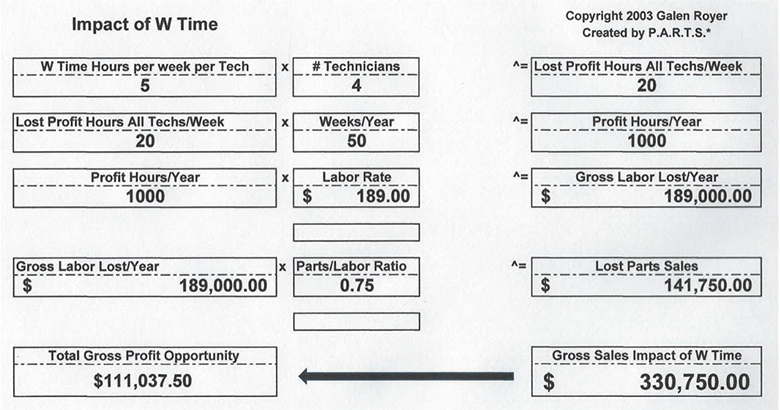
The insert below shows the impact that W-Time could have on your parts and service department income and profit as well as how minimizing W-Time could decrease the RECT for your operations.
One method of reducing some of the W-Time incurred by technicians is to designate a service technician parts associate (STPA) to support the technicians. This STPA could communicate with the person who dispatches work orders to the technicians so that any parts, accessories, materials and special tools required for a work order might be researched and set aside for delivery to the technician’s work area when the work order is assigned. By delivering any items required for a work order, the STPA reduces the W-Time incurred by technicians. If this STPA concept interests you, please email me for some documents related to this concept.
For any periods when the STPA is not supporting the technicians, he could be performing cycle counts of assigned areas of the parts and accessories inventory display and storage locations. This minimizes the opportunity for the STPA to be nonproductive.
If you are concerned that this added position will add to your personnel expense, please refer to the W-Time chart for an example of the additional Gross Profit opportunity achieved by reducing the technicians’ W-Time. This additional GP could justify that additional personnel expense.
More Work?
Yes, more Selway suggestions that could create some additional work for you or your managers. Yet, by implementing any of these ideas, you could also increase the amount of work that your technicians can produce!