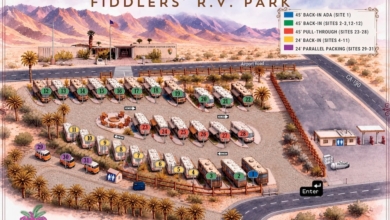
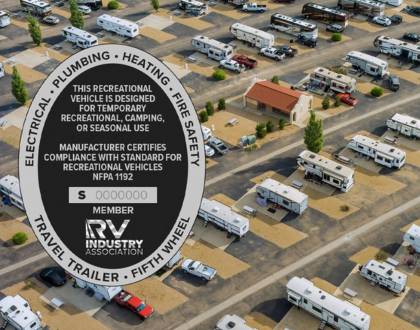
Campgrounds and RV parks are where the hard work of manufacturing standards meets real-world application. Every day, park operators manage complex electrical grids, centralized water supplies, and shared spaces designed to host hundreds of RVs simultaneously.
While roughly 98% of all RVs built in North America are produced by RV Industry Association member manufacturers, the remaining market includes non-member units that may or may not comply with safety standards. For campground management, allowing vehicles without a seal onto a site could introduce uncertainty as to whether non-member units are built to any safety standards.
That is why many public and private campgrounds across the United States require an affixed RV Industry Association (RVIA) Seal for park entry. The seal acts as immediate visual confirmation that the unit’s manufacturer certified that it was engineered and built in compliance with rigorous, industry-adopted safety standards and that the manufacturer underwent routine, unannounced audits to verify compliance.
Protecting the Power Grid: Electrical Compliance
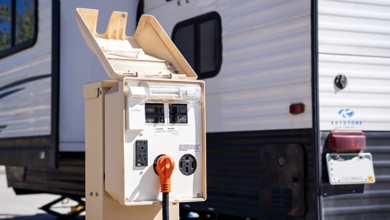
When a vehicle with improperly grounded or configured wiring, incorrect wire sizing, or faulty circuit protection plugs into a campground pedestal, it risks tripping main breakers, damaging park electrical infrastructure, or creating fire hazards.
By requiring the RV Industry Association Seal, campground operators can have the peace of mind that every vehicle connecting to their power pedestal was built by a manufacturer that certifies compliance with:
- National Electrical Code (NEC): Ensuring correct wire gauge, ground-fault circuit protection, proper grounding, listed electrical equipment, and breaker sizing.
- ANSI/RVIA DC Standard: Regulating DC electrical systems, batteries, connections, wiring, fusing, solar, and internal DC distribution to prevent thermal overloads and short circuits.
Because member-built units are subject to more than 2,000 unannounced inspections annually, park operators can rest assured that professional inspectors spot-checked units (including electrical systems) at various stages of construction on the assembly line at each manufacturer’s plant.
Safeguarding Environmental & Water Safety
Water and waste hookups are equally critical shared utility systems. A failure in an RV’s plumbing or fuel system does not just affect one vehicle—it can impact neighboring sites and local environments.
The seal communicates that a manufacturer certifies that the vehicle complies with NFPA 1192 (or ANSI A119.5 for park model RVs):
- Backflow Prevention: Safeguards the campground’s potable water supply from potential cross-contamination.
- Piping & Leak Integrity: Ensures pressure-tested LP gas and water distribution systems, secure drainage lines and compliant containment systems.
- Ventilation & Fire Safety: Guarantees certified appliance venting, emergency exit sizing and active smoke/CO detection.
Distinguishing Association Member Rigs From Non-Member Builds
Campground managers and check-in staff do not have the time or expertise to conduct multi-point safety inspections at the front gate. The physical seal provides a clear, standardized baseline.
“The RV Industry Association Seal gives park operators instant verification that the manufacturer of the vehicle has pledged that the unit has been constructed in adherence with adopted safety codes, backed by the association’s audits along the manufacturer’s assembly line.”
An affixed RV Industry Association seal confirms that a manufacturer certifies that its purpose-built RV or Park Model RV adheres to over 500 safety requirements. Enforcing seal-based entry rules gives operators an objective, standardized criterion to maintain park integrity.
A Collaborative Safeguard for Outdoor Hospitality
Campgrounds, manufacturers and dealers share a mutual goal: ensuring guests enjoy safe, memorable outdoor experiences without preventable hazards.
If a campground operator chooses to recognize and enforce a requirement for the RV Industry Association Seal, such campground operator can feel confident that the product on its campground was made by manufacturers that certify compliance with rigorous, industry-adopted safety standards.